The argument
An agency's own marketing is the one account nobody owns
Redha Alayesh is a marketing consultant who has worked with 40+ marketing departments. This is his argument for why agencies neglect their own marketing, and why being busy has nothing to do with it.
When did your agency's own account last post? Answer without checking. Now: when did your biggest client's account last post? If you run an agency, the second answer probably came faster.
In Saudi Arabia there is a proverb for this: باب النجار مخلوع, "the carpenter's door is broken". People say it about marketing agencies with something like relief, because it explains the problem and excuses it in the same breath. And the excuse comes built in: the carpenter is busy with everyone else's doors.
Being busy is not why the door is broken. The door is broken because it has no owner. An agency's own marketing is the one account in the building with no client asking about it, no deadline, no written budget and no person whose name is on it.
I am writing this for the agency founder whose new business mostly arrives by referral, and who has decided the agency's own account can wait. This year in particular, waiting costs more, because referrals themselves are weakening fast. And before a referred client calls you, what do they do first?
Why does an agency's own marketing always come last?
An agency's own marketing comes last because it is the only account nobody asks for. A client account comes with three alarms: a WhatsApp group that asks where Tuesday's post is, a contract with a delivery date, and an account manager who answers for the delay. The agency's own account has none of them. No message will ever arrive asking why the agency's post went missing this week.
This is not an impression. Databox, working with the agency adviser Karl Sakas of Sakas & Company, surveyed agency leaders in 2023 and reported on the first 210 responses. In 71% of agencies, "the owner or founder also wears the CMO's hat". In 62%, owners or founders handle the day-to-day execution of the agency's own marketing themselves. And 31% "don't have a formal marketing budget at all". The report's own summary is blunter than mine: "Compared to clients, agency self-promotion efforts are less strategic, less structured, and de-prioritized."
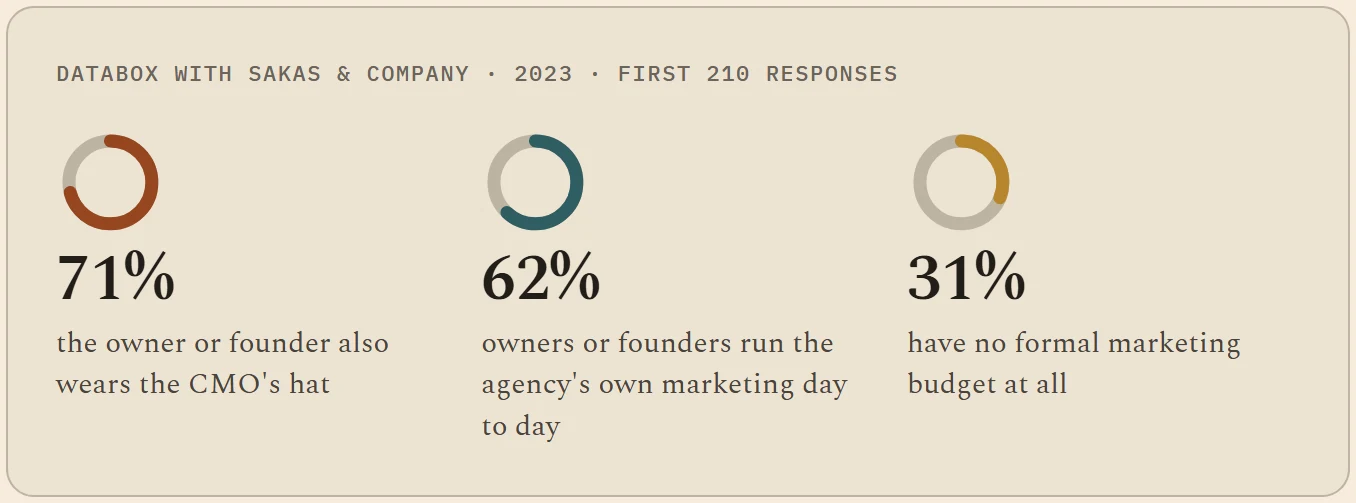
When the founder is responsible for everything, nobody is responsible for the agency's marketing. A founder's time goes to whoever asks first: an unhappy client, a proposal due tomorrow, someone on the team waiting for a decision. The agency's own account never asks.
And each week, putting the client first is the right call. Clients pay the salaries, and the agency's account pays nothing this month. Agencies are generous with their clients' accounts and stingy with their own, and every stingy week has a good reason. The trouble is that the right call, made fifty weeks in a row, adds up to a year with no marketing.
Is being busy the real reason?
Being busy is the symptom, not the cause. Look at the busy week itself. In the week nothing went out on the agency's account, every client post went out on time. The hours existed. What was missing was a person who would be asked about the agency's account.
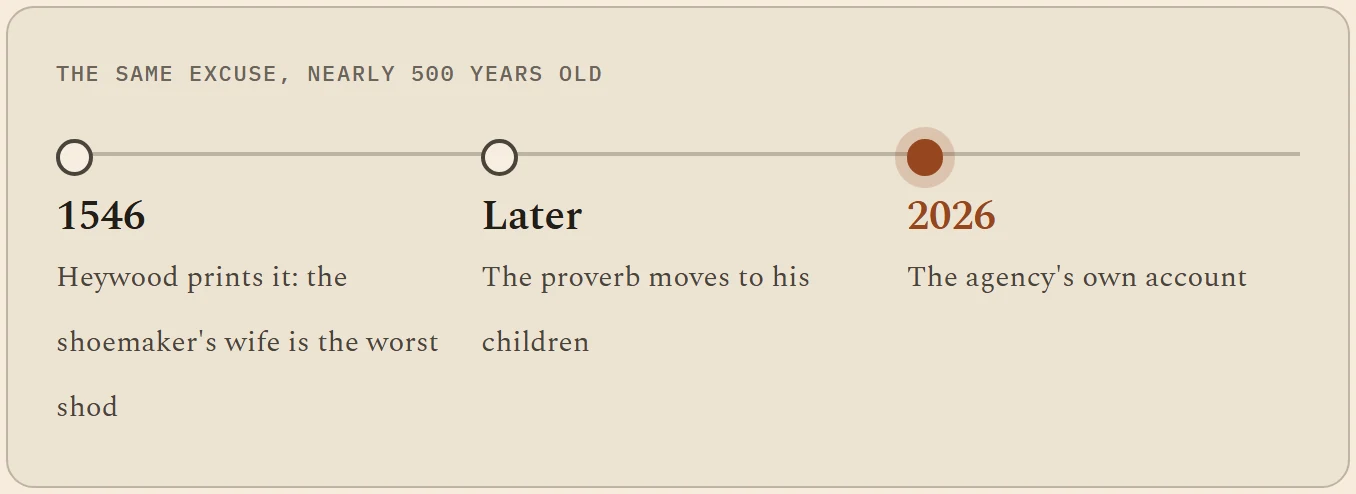
It is also an old excuse. John Heywood's collection of English proverbs, first printed in 1546, already has it: "But who is worse shod than the shoomakers wife? With shops full of new shooes all her life?" It was the shoemaker's wife then. Somewhere along the way it became his children. Nearly five hundred years, and the only thing that has changed is who goes barefoot.
I know this from the inside, because I was the carpenter. This piece started as a line I said in late October, that باب النجار مخلوع would make a good post for marketing agencies, and I am writing it knowing it applied to me first. Before I started any of my companies, I freelanced marketing for a full year and made 8,000 riyals. For the whole year. I was not busy. I had more free time than any agency founder. Yet I had no profile, no presence, and nobody knew I existed. No clients to be busy with, and the door was broken anyway.
The second excuse is "we have nothing to say". That is a symptom too. Whoever owns the account finds out in the first week that they cannot publish without a position, so they are forced to pick one. Without an owner, that question waits with everything else that waits.
Does an empty agency account matter if the work is good?
It matters because the agency's own account is the only sample of its work a buyer sees with nobody in between. The portfolio is curated. Case studies need the client's sign-off. The agency's own account is the one place it cannot blame a client's approvals: no client sat on the sign-off, and nobody else set the budget. Every decision on it is the agency's, and buyers read it that way.
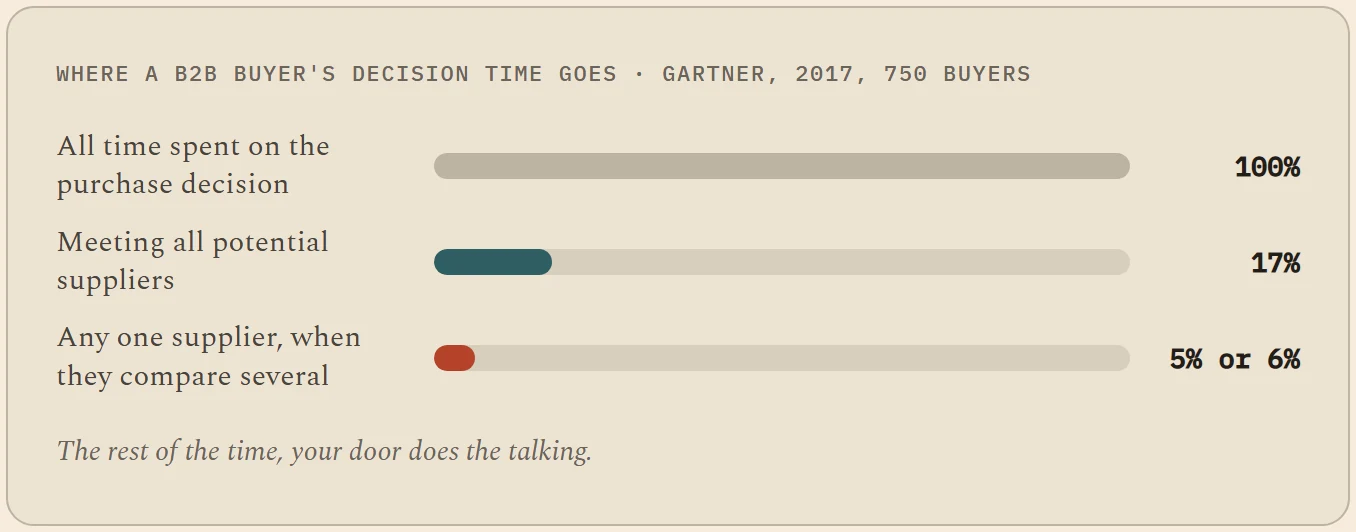
And buyers make most of the decision while you are not in the room. In a 2017 survey of 750 B2B buyers, Gartner found that buyers considering a purchase "spend only 17% of that time meeting with potential suppliers", and that when they compare several suppliers, "the amount of time spent with any one sales rep may be only 5% or 6%". The rest of the time they spend away from you. In that time, your door does the talking.
Which brings us back to the referred client from the start. Before they call you, all they have is your name. And the first thing anyone does with a name is type it into a search bar.
Aren't referrals enough?
The strongest objection to all of this is that referrals are enough, and it deserves its full form. "Our clients come by referral." A referred client is often among the best an agency gets, because the trust arrives before they do. And an agency that cuts into client hours to post about itself is making a bigger mistake than the one it is trying to fix.
But a referral is a channel the agency does not control. Former clients decide it, on their own schedule. It is exactly what agencies warn their clients about: depending on one channel that someone else controls.
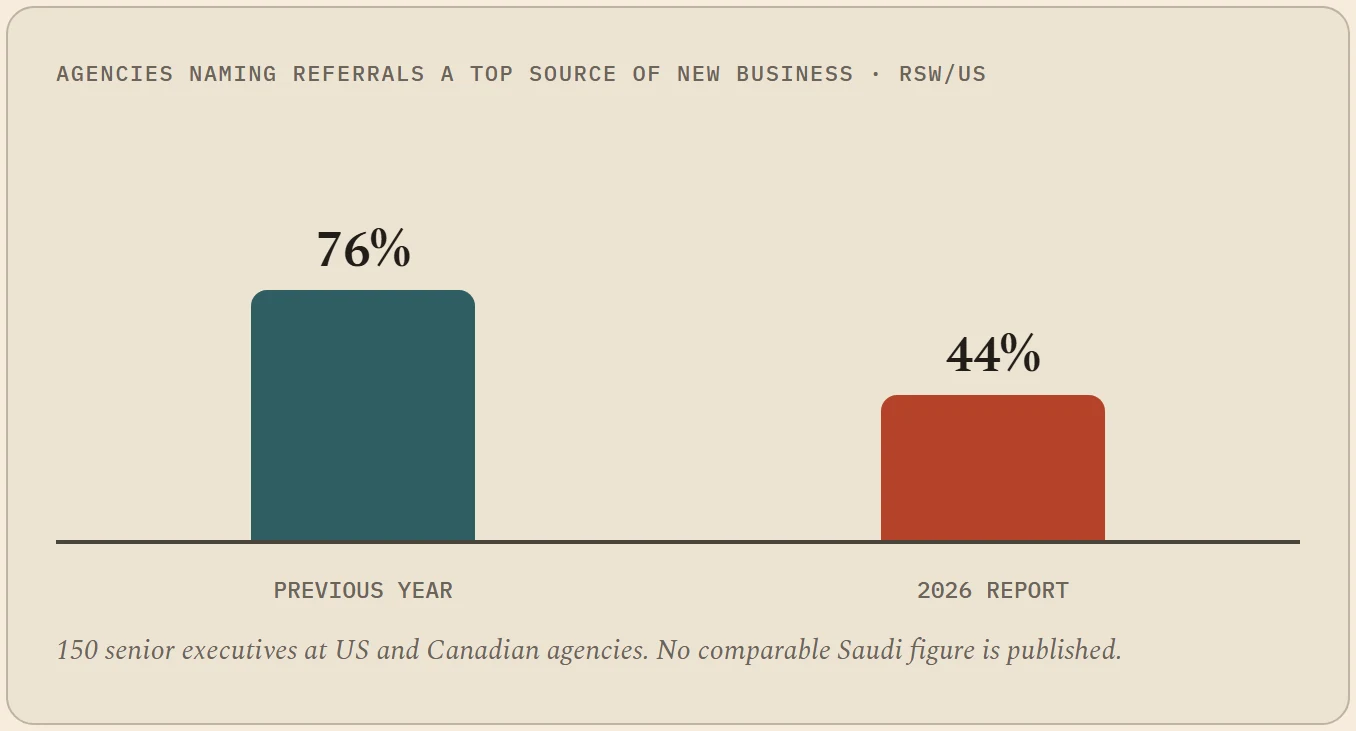
And the channel is weakening. RSW/US surveys agencies about new business every year, and its 2026 report, published in October 2026 from a survey of 150 senior executives at advertising, marketing and PR firms in the United States and Canada, says referrals fell from 76% to 44% as a top source of new business in one year. RSW/US sells outsourced new business to agencies, which is worth knowing when it reports that referrals are drying up. I know of no published figure like it for agencies in Saudi Arabia. I might be wrong about the timing here, not the direction.
An agency that will need a second channel next year has to start building it now. An account built during a crisis is built late.
What does it mean to treat your own agency as a client?
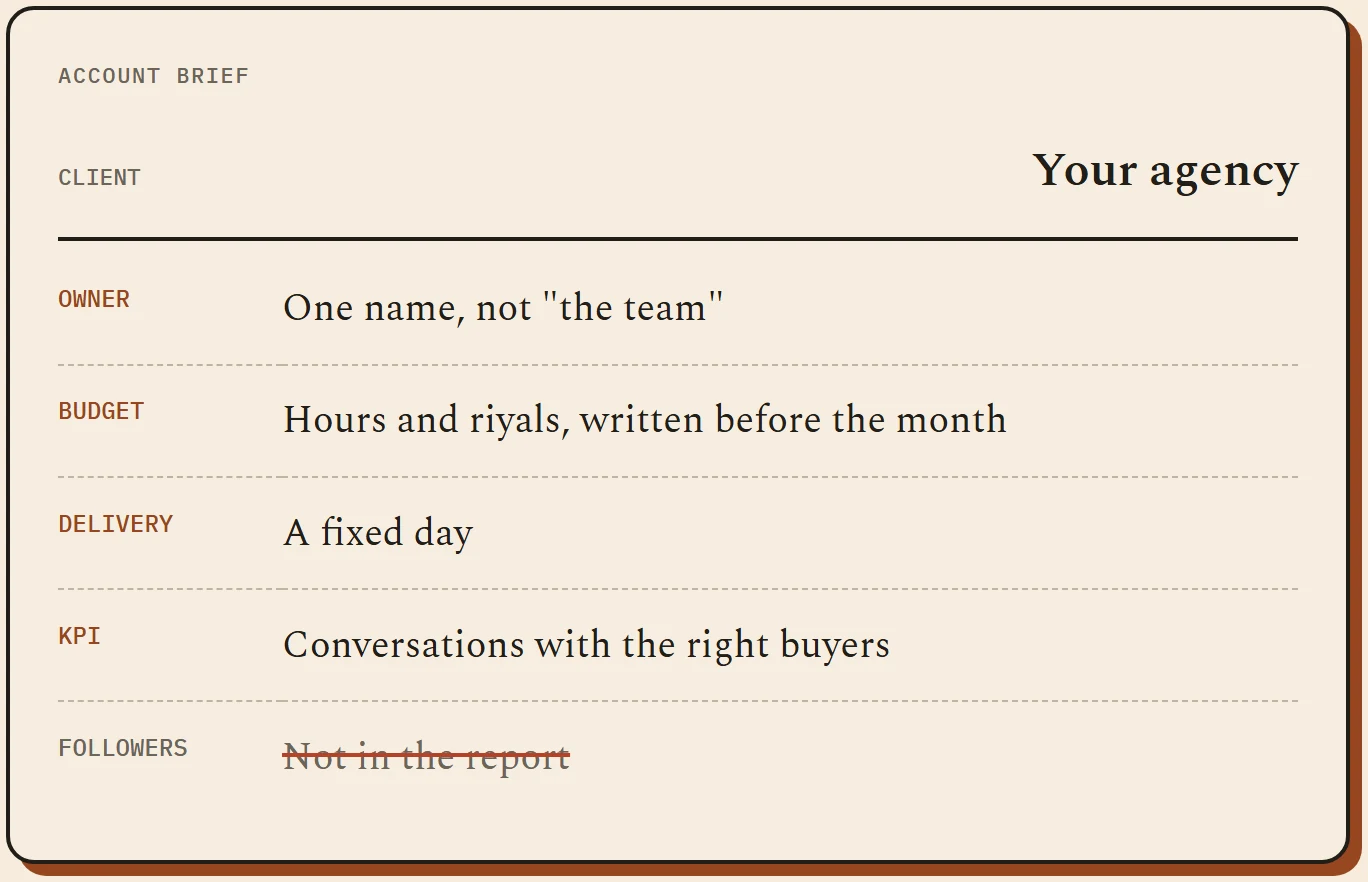
Treating your own agency as a client means giving its account the four things any client account gets, without exception:
- An owner by name. One person who gets asked, not "the team". It can be the founder, if the founder books time for it the way they would for their hardest client.
- A budget written before the month starts. In hours and in riyals, like any quotation the agency sends out.
- A fixed date. A known delivery day, as in any contract, not "when we're free".
- One number, read every month. A clarity metric, not a vanity metric: how many conversations with the right buyers came through the account. Follower counts stay out of the report.
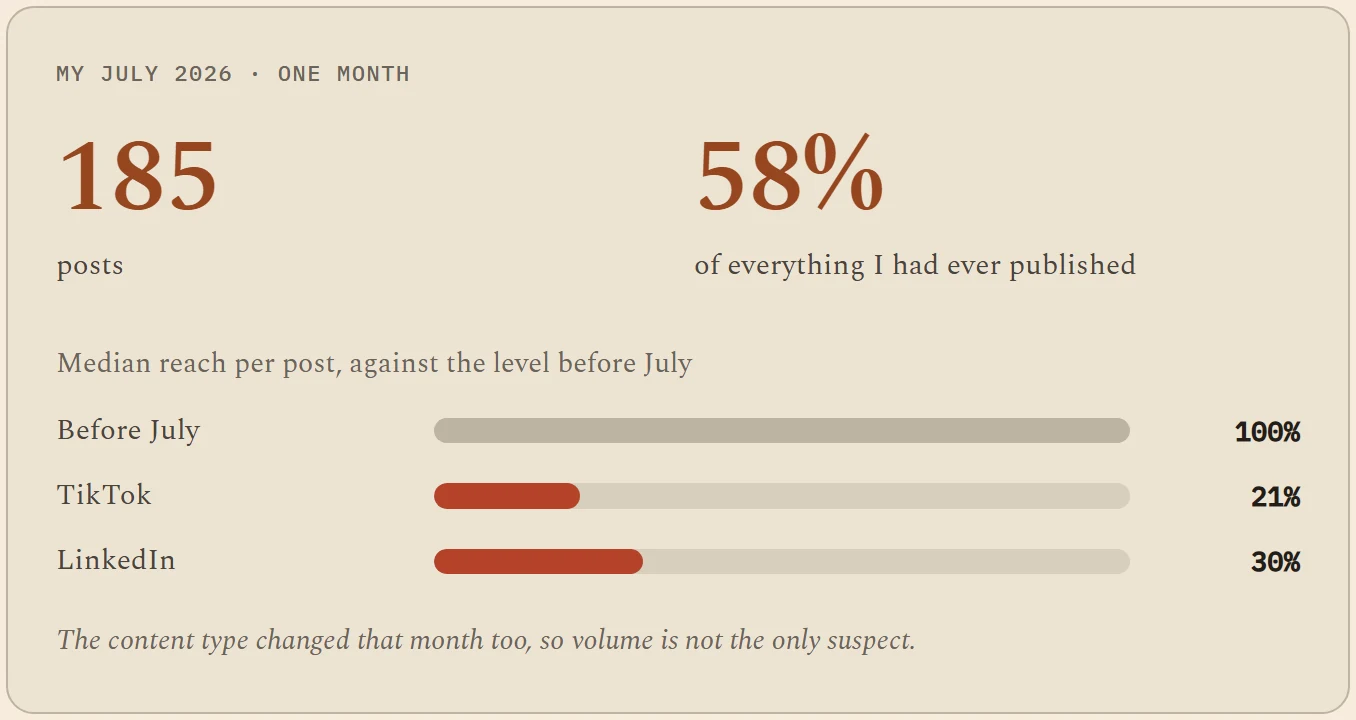
The number is the one I paid the most to learn. In July 2026 I published 185 posts in one month, 58% of everything I had ever published. The door had an owner this time, and the owner was me. My median reach per post fell to 21% of its earlier level on TikTok, and to 30% on LinkedIn. I also changed what I posted that month, so volume is not the only suspect. What is certain is that the July way of working did worse than what came before it, and the drop only showed up when I went through the numbers in August.
An owner with no number is a louder carpenter.
Your agency is a client. Give it an account manager.